 listicle
Private Scan for Pregnancy Peace of Mind: 2026 Guide
Table of Contents
- What a Private Scan for Pregnancy Peace of Mind Actually Shows
- Early Pregnancy Reassurance Scan: What Can Be Seen at 6, 8 and 12 Weeks
- When to Book Your First Pregnancy Scan
- Is a Private Pregnancy Scan Safe? Clinical Standards and Who Should Scan You
- Private Blood Test for Pregnancy and NIPT: What Bloods Can Add
- What to Expect at Your Appointment, and What Happens If Something Is Found
- Frequently Asked Questions
Last Updated: September 22, 2026
What a Private Scan for Pregnancy Peace of Mind Actually Shows
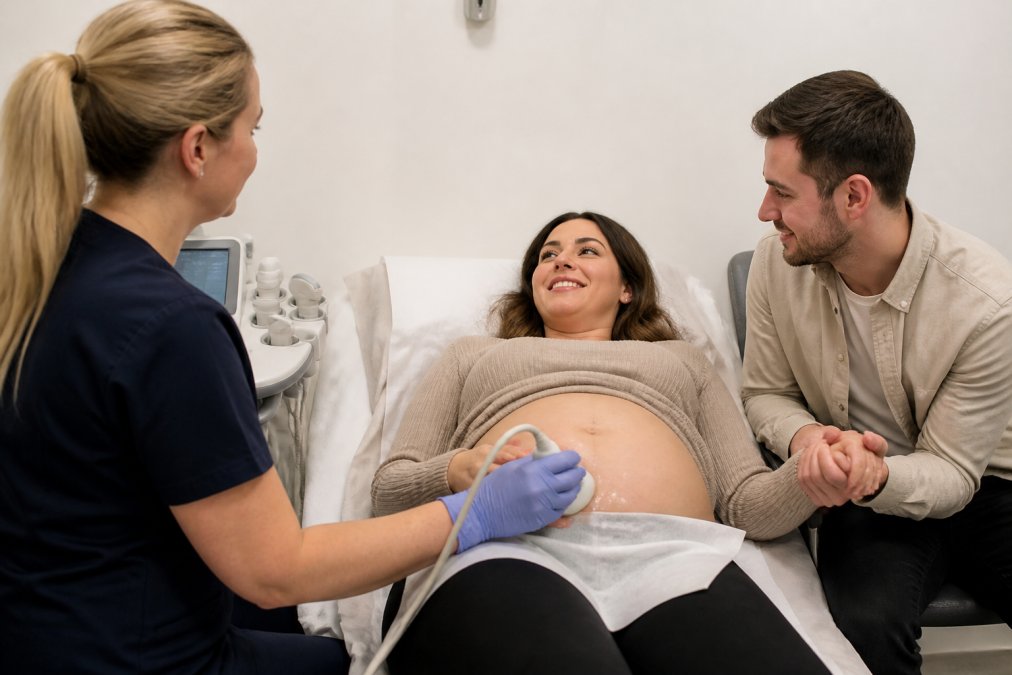
A private scan for pregnancy peace of mind is an ultrasound, usually booked without a GP referral, that can confirm a fetal heartbeat, check gestational age and let you see your baby between NHS appointments. At Little Stars 4D Scan, our clinics in Nottingham, Sheffield and Stoke-on-Trent run early reassurance scans from around six weeks, with same-week appointments and female sonographers registered with the HCPC, BMUS and SoR.
2D, 3D, 4D and HD: Which Scan Technology Does What
Each technology answers a different question. Pick the one that matches what you want to know.
| Scan type | What it shows | Best for |
|---|---|---|
| 2D | Internal structures, fetal heartbeat, measurements | Dating, viability, reassurance |
| 3D | Still three-dimensional images | Clear still pictures of baby |
| 4D | Moving three-dimensional images | Bonding, family viewing |
| HD Live | Softer, more detailed moving images | Keepsake imaging later in pregnancy |
Early Pregnancy Reassurance Scan: What Can Be Seen at 6, 8 and 12 Weeks
An early pregnancy reassurance scan is a first-trimester ultrasound to confirm a pregnancy is progressing as expected. What the sonographer can show you depends almost entirely on how many weeks pregnant you are.
- Around 6 weeks: a gestational sac, and often a fetal heartbeat, though it may be too early for a clear view and a repeat scan may be needed
- Around 8 weeks: a measurable embryo, a heartbeat, and clearer dating
- Around 12 weeks: recognisable profile, limb movement, and the point at which the NHS dating scan usually takes place
When to Book Your First Pregnancy Scan
Book your first private scan when uncertainty is affecting your day-to-day wellbeing, not on a fixed schedule. There is no clinical rule that says you need one. Research in the Sociology of Health & Illness study on women's motivations for private scans found that reassurance and bonding are the main reasons women book, rather than a specific medical concern.
- Light spotting or cramping that your GP has not yet investigated
- A previous loss, where the wait for the 12-week scan feels unbearable
- IVF or fertility treatment, where early confirmation matters
- Symptoms that have suddenly changed or disappeared
- Simply wanting to see your baby before the NHS appointment
The Emotional Case for an Early Scan
Most articles about private scans focus on what the scan shows; far fewer talk about what the waiting does to you. If you have had a previous loss, are pregnant after fertility treatment, or simply feel something is not quite right, the weeks between a positive test and the NHS dating scan can be genuinely difficult. Anxiety in early pregnancy is common, and it is not a sign that anything is wrong with you or your baby.
A Simple Decision Framework
If you are weighing up whether to book, ask yourself three questions:
- Is my uncertainty time-limited? If your NHS scan is next week, waiting may be easier than arranging a private appointment. If it is six weeks away, that is a different calculation.
- Would a clear result change how I feel day to day? If yes, an early scan may be worthwhile. If no result would fully reassure you, the scan may not be the right tool.
- Do I have symptoms that need clinical assessment? Spotting, cramping or pain should be discussed with a clinician, not managed by booking a scan alone.
What If You Decide to Wait?
Waiting is a valid choice. If you hold off, the following can make the wait more bearable:
- Keep a simple symptom diary so you can see patterns rather than focusing on day-to-day fluctuations
- Share how you are feeling with your partner, a friend or your midwife, you do not have to carry the uncertainty alone
- Avoid repeated home pregnancy tests, which cannot tell you how a pregnancy is progressing and often increase anxiety
- Contact your GP or midwife if you have any symptoms that concern you, rather than waiting for your next appointment
Is a Private Pregnancy Scan Safe? Clinical Standards and Who Should Scan You
Ultrasound is widely regarded as safe in pregnancy when performed by a trained professional for an appropriate reason, but the operator matters more than the machine. A BBC News investigation into private baby scan clinics reported expert concerns about untrained staff in high-street clinics and warned that such services can provide false reassurance rather than clinical clarity.
Questions worth asking any clinic before you book:
- Are your sonographers registered with a professional body?
- Is the clinic CQC-registered?
- Will I receive a written report for my midwife, GP or consultant?
- What happens if the scan cannot give a clear answer?
- Is there a policy on repeat scans?
Private Blood Test for Pregnancy and NIPT: What Bloods Can Add
A private blood test for pregnancy adds information an ultrasound cannot provide, including hormone levels and chromosomal screening. Ultrasound shows structure; bloods show what is happening at a biochemical level.
Two categories are worth knowing:
- Diagnostic bloods: hCG levels, progesterone, thyroid function, iron studies and general wellness panels, useful when tracking an early pregnancy or investigating fertility concerns
- NIPT (non-invasive prenatal testing): a maternal blood test that screens for conditions such as Down's syndrome, Edwards' syndrome and Patax syndrome, with microdeletion panels available at higher tiers
What to Expect at Your Appointment, and What Happens If Something Is Found
Expect a calm, unhurried appointment with a clear explanation of what is visible and what is not. At our clinics you will be scanned by a female sonographer, given time to ask questions, and sent away with a detailed report for your GP, consultant or midwife. Little Stars 4D Scan provides private ultrasound, pregnancy, and fertility scanning services, alongside comprehensive blood testing and DNA testing.
Diagnostic vs Keepsake Scans: What You Are Actually Booking
It is worth understanding the difference before you book, because the two serve different purposes.
- Diagnostic scans are performed to answer a clinical question: is the pregnancy viable, how far along are you, is the placenta in a normal position, are there any structural concerns. They are carried out by a registered sonographer and produce a written report.
- Keepsake scans are for bonding and family viewing. They produce images and videos for you to keep, but they are not intended to diagnose anything. A keepsake scan should never be used instead of a diagnostic scan.
If Something Unexpected Is Found: A Step-by-Step Protocol
Most scans are straightforward. But sometimes the sonographer sees something that needs further review. Here is what happens next, and what you should expect from any clinic.
- The sonographer explains what has been seen, in plain language. You should not be left guessing or googling in the car park.
- You receive a written report the same day. This report goes to your GP, midwife or consultant, who can act on it.
- You are told what the finding might mean, and what it does not mean. A soft marker, for example, is not a diagnosis. It is a finding that slightly increases the chance of a condition and usually warrants further screening, not immediate alarm.
- You are advised on how quickly to seek follow-up, and where. Some findings need same-day review; others can wait for your next scheduled appointment. You should be told which applies to you.
- You are given a point of contact. If you have questions after you leave, you should know who to call.
Soft Markers and What They Actually Mean
At our CQC-registered clinics in Nottingham, Sheffield and Stoke-on-Trent, every scan includes a written report and a clear explanation of what was seen. If you would like to book an appointment or ask a question before booking, our team is here to help.
Frequently Asked Questions
What is a private peace of mind pregnancy scan?
It is a private ultrasound appointment you book yourself, without a GP referral, to check how a pregnancy is progressing and to see the baby. A sonographer confirms the gestational age, checks the fetal heartbeat, and reviews the placental position and amniotic fluid. It is not a replacement for your NHS antenatal care. Little Stars 4D Scan runs these scans at its clinics in Nottingham, Sheffield and Stoke-on-Trent, with same-week appointments and a written report you can share with your midwife or GP.
At how many weeks can I have a private early pregnancy scan?
An early pregnancy reassurance scan is usually offered from around 6 weeks, when a gestational sac and sometimes a heartbeat can be seen. At 8 weeks the embryo is easier to measure, and by 12 weeks the dating is more precise. What is visible depends on your actual gestational age, so if the scan is too early you may be asked to return in a week or two. Little Stars 4D Scan offers early reassurance scans from about 6 weeks at its Nottingham, Sheffield and Stoke-on-Trent clinics.
Is a private ultrasound safe for my baby?
Ultrasound is a well-established imaging method with no known harmful effects at diagnostic levels, and scans are kept as short as possible. Safety in practice also depends on who performs the scan. Reports have raised concerns about untrained staff in some high-street clinics giving false reassurance. Choose a provider whose clinics are CQC-registered and whose sonographers are registered with the HCPC, BMUS or SoR, as they are at Little Stars 4D Scan.
Can a private scan detect pregnancy complications?
A scan can identify some concerns, such as a pregnancy that is not progressing as expected, reduced fetal movements, cervical length changes or placental position issues. It cannot detect everything, and some conditions need blood tests, NIPT or specialist referral. If something is found, a good clinic explains the finding and sends a report to your GP, consultant or midwife so you are not left to interpret it alone. Book with Little Stars 4D Scan in Nottingham, Sheffield or Stoke-on-Trent for a report you can act on.